Posts

Showing posts with the label kravmaga

Returning to Jiu-Jitsu

Image
Last night I returned to Jiu-Jitsu training at One Spirit Martial Arts , the HQ for Professor Pedro Sauer's association. I had suspended my membership in August last year in order to concentrate on my KMG G1 grading . It was very good to be welcomed back to OSMA. Several of my old training partners and instructors were there, and it was good to catch up with them. We started the class with some functional movement drills. We started in cross-mount, then moved to mount, then moved to cross-mount on the other side. We then moved to the opposite side in a reverse motion. The goal was to be as technically correct as possible and capture all the details that make life difficult for the person on the bottom. For techniques, we worked a standing self-defense move against a thumbs-down grip, transitioning to a standing arm bar. On the ground, we worked on the arm bar from the guard. My partner was a blue belt who helped me with the movement mechanics for transitioning from the guard to a p...

2018 Martial Arts Year in Review

Image
2018 was my third full year practicing martial arts, since my  return in January 2016 . About a year ago I posted my  2017 Martial Arts Year in Review , reporting some statistics on my training and how I spent that time. Krav Maga In 2018 I began my third year of training at First Defense Krav Maga in Herndon, VA. I started the year as a P4. Prior to my P5 test in March, I participated in 29 formal Krav Maga classes. (I had trained 58 hours since my P4 test.) Between my P5 test and my G1 test in December, I participated in 91 Krav Maga classes. After my G1 test and through the end of December, I participated in 3 Krav Maga classes. That is a total of roughly 123 hours of regular Krav Maga classes, down from 130 in 2017 and 144 in 2016. In addition to regular classes, in July I attended a seminar with Master Eyal Yanilov on countering active shooters. That is a total of roughly 3 hours of special events, down from 93 in 2017 and 73 in 2016. Combined with my formal classes, I sp...

Thoughts on my Krav Maga Global G1 Test

Image
Sunday I successfully passed my Graduate 1 ("G1") test within the Krav Maga Global system. I last tested for P5 in March 2018 . I wanted to share a few thoughts on how the test went. If you review the krav maga topic link on this blog you will find many posts about my training and philosophy. I started training in the Krav Maga Global system at First Defense Krav Maga in January 2016. My 2016 year in review and 2017 year in review posts document my Krav Maga training journey. As we near the end of 2018, however, I can note that as of this post I trained exactly 120 class hours at First Defense (29 prior to the P5 test and 91 prior to the G1 test), plus 3 hours during the summer in a seminar with master Eyal Yanilov . Thus far I am 6-for-6 with passing scores, having tested roughly every 6 months since starting at the school. The first exception was my P1 test, which occurred in April 2016, 4 months after I began training. The second exception was this G1 test. I had plan...

Eyal Yanilov Seminar Thoughts

Image
Tuesday I was happy to attend another Krav Maga Global seminar by KMG lead instructor Eyal Yanilov. Master Eyal was visiting my hometown KMG school First Defense , which hosted him for their grand opening at their beautiful new location. I first trained with Eyal at the Martial Arts Supershow in 2016 . Eyal was my instructor for the Combat Mindset and Mental Conditioning Class later that year. I also trained with him at the fall 2016 KMG camp  and in the spring of 2017 . When I heard Eyal was going to teach a three hour seminar on countering active shooters, I knew it was a must-attend event. Eyal started the seminar with his perspective on KMG and active shooters. He talked about the inherent conflict between the three KMG missions -- self defense, protecting others, and combat fighting. In self defense, running away may be the best option. When protecting others, sacrificing yourself may be necessary. When fighting in combat, your goal may be to kill the enemy. Knowing the missi...

Thoughts on my Krav Maga Global P5 Test

Image
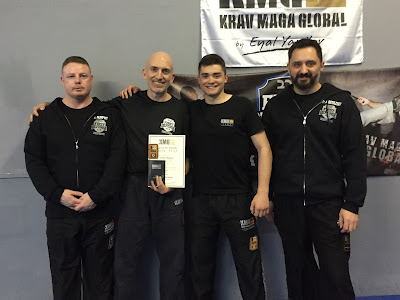
Sunday I successfully passed my Practitioner 5 ("P5") test within the Krav Maga Global system. I last tested for P4 in September 2017 . I wanted to share a few thoughts on how the test went. If you review the  krav maga topic link on this blog  you will find many posts about my training and philosophy. I started training in the Krav Maga Global system at First Defense Krav Maga in January 2016. My 2016 year in review and 2017 year in review posts document my Krav Maga training journey. Thus far I am 5-for-5 with passing scores, having tested roughly every 6 months since starting at the school. The one exception was my P1 test, which occurred in April 2016, 4 months after I began training. There were 5 people testing for P5, and we were the senior students. No one tested for Graduate ("G") ranks that day. As you can see in the picture below, we had a great turnout for ranks P1-P5. My partner was Josh, in the short-sleeved shirt in the top photo. Josh was the MVP ...

Gracie Punch Block Series In Action

Image
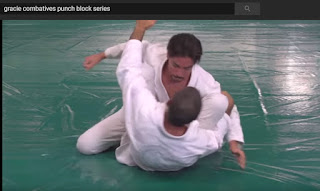
I had a chance to apply Jiu-Jitsu in a striking class recently, and I wanted to share the results with you! One year ago this week I started practicing Brazilian Jiu-Jitsu at Prof Pedro Sauer's school in Herndon, VA. Right away I started with the Gracie Combatives program, and mid-year I began regularly attending the Pedro Sauer fundamentals curriculum classes. Two years ago this month I began practicing Krav Maga at Nick Masi's school in Herndon, VA. Last week ground combat was the focus of the classes. I participated in the Thursday night "fight" class, which is several notches above the intensity of the Wednesday sparring class. Once in a while we go to the ground in a Krav session, but we tend to avoid extended ground contact or pressure. I had only done this sort of dedicated ground striking session once before, and that was in 2016 before I started Jiu-Jitsu. I did not perform very well. I'm 46, 5'9, and less than 145 lbs. If I have to depend on speed,...

Keep Rolling Rolling Rolling

Image
Since starting Brazilian Jiu-Jitsu last year at Professor Pedro Sauer's school , I've had to regularly do forward and backward shoulder rolls. Both are part of the KMG curriculum we follow at my Krav Maga school , but we don't practice as often. I've been trying to improve my backward rolls because they are part of the regular Jiu-Jitsu warmup drills. The instructors and many students can do them slowly, without building momentum. This was my goal, to smoothly roll backward over either shoulder. Recently I watched a video by Stephan Kesting titled 3 Most Common Backwards Shoulder Roll Mistakes . I paid close attention to his technique and took a series of screen captures. Something clicked when I watched him roll backwards towards the camera. The breakthrough for me was watching how Stephan twists his whole upper body off the centerline , and then swings his legs along the centerline . For whatever reason, that clicked with me. I tried focusing on those two elements an...

2017 Martial Arts Year in Review

Image
2017 was my second full year practicing martial arts, since my return in January 2016 . About a year ago I posted my 2016 Martial Arts Year in Review , reporting some statistics on my training and how I spent that time. Because I have no official training scheduled today or Sunday, it's time for me to analyze how I practiced in 2017. For comparison's sake, in 2016 I spent approximately 300 hours in formal training. About two thirds involved Krav Maga. Less than one sixth involved other martial arts, such as Kali, combatives (including my first serious ground work), and Kung Fu. The remainder involved fitness (Jungshin and Ground Force Method) and firearms. Krav Maga In 2017 I began my second year of training at First Defense Krav Maga in Herndon, VA. I started the year as a P-2. Prior to my P-3 test in March, I participated in 50 formal Krav Maga classes. (I had trained 94 hours since my P-2 test.) Between my P-3 test and my P-4 test in September, I participated in 50 Krav Maga...

Managing Nerves

Image
Last week I taught the noon Krav Maga class at First Defense Krav Maga . Our head instructor was out, so rather than cancel he asked if I would like to lead. I decided to focus on the ground techniques in the Krav P2 curriculum, and add in some "white belt Brazilian Jiu-Jitsu" flair. I added the Gracie punch block series (from guard). I also taught how to transition from mount to an S-mount as the opponent tries to roll under you. If the opponent continues to roll, you can let them and then take their back. The students liked the class. As a result, I think, I am teaching again next week. Our head instructor is flying to Las Vegas for nine days of national training and meetings, so I'm teaching all three noon classes next week. I'm nervous, but as I told a friend, feeling nervous confirms three facts: 1) I'm alive; 2) I'm growing; and 3) I care. I could give a talk to an audience about my cybersecurity  methods with little to no preparation, but I've been ...

Avoiding Smash Mouth

Image
Who needs a hobby, or even a lifestyle, that requires getting punched in the mouth? We do! We martial artists are likely to be intentionally or unintentionally smacked in the face many times over the years. We owe it to ourselves to protect the investment our parents made in our braces and trips to the dentist! If you managed to avoid the orthodontist, you have an ever higher duty to protect what your creator gave you! Throughout my martial arts career, I've worn the same mouth gear. When I entered basic training at the Air Force Academy, military dentists took a cast of my teeth and made a form-fitting guard. It sat on my front teeth and helped me avoid injuries during the basic assault course, boxing, and combatives. I was not smart enough to wear it playing pick-up ice hockey (or a helmet, for that matter), resulting in some damage that is a story for another day. (I gave the other guy a scar, too.) Last month I decided to upgrade my protective gear. My old mouth guard was servi...

What Does the Student Need

Image
I've been enjoying the Jiu-Jitsu Brotherhood podcast , hosted by Nic Gregoriades. Nic brings a deep philosophical approach to his jiu-jitsu, and his podcast reflects that thinking. In episode 10 he interviewed Matt Thornton, the famous coach known for his concept of "aliveness" in training. Nic asked Matt for advice on how to be a better martial arts coach. Paraphrasing Matt, his response was the following: When teaching, ask yourself "what does the student need from me, right now, to succeed?" Matt's question really resonated with me. In jiu-jitsu I'm a student, but in Krav Maga I'm a student and a member of our instructor development program. I help teach kids and adult fundamentals classes, and I'm available for private instruction. Matt added that instructors should worry less about "looking good" in front of students, or demonstrating the latest and greatest flashy technique. Instructors should concentrate on getting through to th...

Bouncing Back During the P4 Test

Image
Last weekend I tested for Krav Maga Global Practitioner 4 ("P4") rank. I had last tested in March, for P3. This test taught me a lesson about resiliency and keeping calm in the face of adversity. To grade those of us testing for P4 and above, my head instructor flew in a former student now living in Austin, TX. Will is an Expert 1 known for being a serious grader. We heard he had failed 5 of the last 7 people he tested for Graduate rank. I had trained for a while with Will before he moved from northern VA to TX, so I knew he was tough but fair. The first hour and a half went well and soon it was time for me to demonstrate "stop kicks." You have probably seen these in Bruce Lee's Jeet Kune Do -- using the lead or rear leg to intercept and block an opponent's low kick. I had just worked on these with our kids classes that morning, so I felt ready to go. It was not meant to be! I couldn't stop a single kick my partner threw at me. Will even swapped out my o...

Krav Maga Global Training for Jiu-Jitsu Practitioners

Image
I've been a Brazilian Jiu-Jitsu practitioner since the very end of January 2017. I listen to several BJJ podcasts, and I sometimes hear participants critique Krav Maga. Some of the popular comments include the following: Krav Maga is mainly groin kicks, eye gouges, and palm strikes.  You don't need a long time to learn Krav Maga. In fact, you could learn the system in a week. If you practice authentic, self-defense Gracie Jiu-Jitsu, you don't need to learn a so-called "reality-based self-defense system" like Krav Maga.  Krav Maga students say their techniques are too deadly to train against live, resisting opponents. Yet, "aliveness" is the key to training. Therefore, Krav Maga is of little use in real confrontations. I've been training in the Krav Maga Global system since January 2016. I'm a "practitioner 3" who has completed the first five days of our 24 day General Instructor Course. I'm no expert but I'd like to offer my rea...

Five Exercises to Relieve Martial Arts Wrist and Finger Pain

Image
Do sore wrists and fingers interfere with your martial arts training? I stopped training martial arts training in 2001 after I broke my wrist in American Kenpo class. I didn't know I had broken it until several weeks later, when a doctor took an X-ray and saw the wrist was healing. I had "protected" it using the sort of wrist brace you use for carpal tunnel syndrome. The doctor said "that's going to hurt again in 10 or 15 years." Here we are in 2017, and I don't want this old injury to hold me back! My family also has a history of developing arthritis in the fingers, so I am doing what I can to avoid that situation as well. Earlier this year I felt wrist pain when doing Krav Maga striking drills, and finger pain doing Brazilian Jiu-Jitsu. I decided to fight back with a multi-pronged approach. Let me share the drills I do to relieve martial arts wrist and finger pain! 1. Wrist strength. I was inspired by my StrongFirst training to focus first on wrist s...

Sportification of Martial Arts

Image
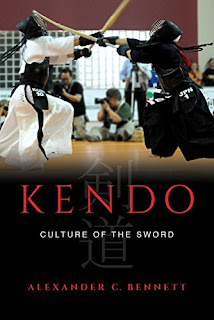
I'm reading Kendo: Culture of the Sword by Alexander C. Bennett. I started reading it to better understand the history of Kendo, which I've mentioned a bit here. As you might imagine, Kendo started as a battlefield practice. It was one manifestation of the combat art employed by sword-wielding Japanese warriors. Over time, as the leaders of Japan sought to reduce bloodshed, sword combat became less common. Swords were used in warfare, but as Japan became more peaceful, the numbers of "sword battle veterans" diminished. Various parties sough to continue to infuse the spirit of sword fighting in certain elements of the citizenry, leading to the development of Kendo and its sport elements. I'm currently reading the part of the book that deals with the re-militarization of Kendo, due to the wars Japan fought in the first half of the twentieth century. This is a fascinating phenomenon which I have not encountered (yet) with other martial arts. Following World War II,...

Longevity in the Martial Arts

Image
How long can we train in the martial arts? As a 45-year-old who returned to practice in January 2016, I've been pondering this question for the past few weeks, in three separate ways. First, in episode 161 of the Whistlekick podcast , a practitioner of the Chinese martial arts said that as a younger man he focused on the so-called "hard" or "external" styles, and as he aged he transitioned to the "soft" or "internal" styles. For example, you might begin learning Wing Chun or Kung Fu, then migrate to Tai Chi, or spend more time on Kung Fu forms instead of sparring. I have done some Wing Chun and Tai Chi, but the majority of my Chinese practice involves Kung Fu forms. Second, I participated in Professor Pedro Sauer's Brazilian Jiu-Jitsu spring camp in Herndon, VA. Professor is in his late 50s and he talked about the importance of learning technique rather than relying on strength. He said it is good to have strength, but you should "ke...

How to Win Wearing a Gracie "Boyd Belt"

Image
A month or so ago I began listening to the Gracie Jiu Jitsu Rocks podcast , produced by Marty Josey. All of the podcasts are excellent, but I really enjoyed episodes 32 and 33 which offered advice for older practitioners like myself. One of those episodes included an excerpt from a Gracie Breakdown titled  Jiu-Jitsu Over 40 (5 Rules to Roll Till 95) . The first rule was "know your Boyd Belts," named for a former Gracie Jiu Jitsu black belt instructor who began practicing in his 40s and continued until his passing in his 60s. His name was John Boyd, but he is not the same John Boyd who invented the OODA loop . In the video, Rener explained how one day John was disappointed that he could not beat a blue belt with whom he had just rolled. Rener learned that the blue belt was 40 years younger (mid-20s vs mid-60s) and 60 pounds heavier (220 lbs vs 160 lbs) than John. Rener and Ryron analyzed this situation and devised the "Boyd Belt" framework. Simply stated: Every 20...