Posts

Bouncing Back During the P4 Test

Image
Last weekend I tested for Krav Maga Global Practitioner 4 ("P4") rank. I had last tested in March, for P3. This test taught me a lesson about resiliency and keeping calm in the face of adversity. To grade those of us testing for P4 and above, my head instructor flew in a former student now living in Austin, TX. Will is an Expert 1 known for being a serious grader. We heard he had failed 5 of the last 7 people he tested for Graduate rank. I had trained for a while with Will before he moved from northern VA to TX, so I knew he was tough but fair. The first hour and a half went well and soon it was time for me to demonstrate "stop kicks." You have probably seen these in Bruce Lee's Jeet Kune Do -- using the lead or rear leg to intercept and block an opponent's low kick. I had just worked on these with our kids classes that morning, so I felt ready to go. It was not meant to be! I couldn't stop a single kick my partner threw at me. Will even swapped out my o...

Krav Maga Global Training for Jiu-Jitsu Practitioners

Image
I've been a Brazilian Jiu-Jitsu practitioner since the very end of January 2017. I listen to several BJJ podcasts, and I sometimes hear participants critique Krav Maga. Some of the popular comments include the following: Krav Maga is mainly groin kicks, eye gouges, and palm strikes.  You don't need a long time to learn Krav Maga. In fact, you could learn the system in a week. If you practice authentic, self-defense Gracie Jiu-Jitsu, you don't need to learn a so-called "reality-based self-defense system" like Krav Maga.  Krav Maga students say their techniques are too deadly to train against live, resisting opponents. Yet, "aliveness" is the key to training. Therefore, Krav Maga is of little use in real confrontations. I've been training in the Krav Maga Global system since January 2016. I'm a "practitioner 3" who has completed the first five days of our 24 day General Instructor Course. I'm no expert but I'd like to offer my rea...

Quit Playing Games with My Heart

Image
Have you seen this chart, or have you heard about the topic it describes? (Scroll to the very bottom of the post for TL;DR if you like!) From "On Combat", as rendered by Amazon.com. Not for commercial use. In brief, as I have heard it taught and as this chart explains, the higher your heart rate, the worse your physical performance. This idea has implications for anyone in a physical confrontation, where an increased heart rate seems to mean an inability to perform self defense actions. When I first encountered this concept, it did not make sense to me. In my teens I was a high school cross country and track runner, and I frequently elevated my heart rate over 200 bpm. I did not encounter these symptoms. In my twenties and thirties I played men's league ice hockey and managed to perform complex motor skills such as skating, puck handling, and shooting, all while my heart was racing.  Now, encountering this chart and its ideas as a martial artist, I'm learning that I s...

Five Exercises to Relieve Martial Arts Wrist and Finger Pain

Image
Do sore wrists and fingers interfere with your martial arts training? I stopped training martial arts training in 2001 after I broke my wrist in American Kenpo class. I didn't know I had broken it until several weeks later, when a doctor took an X-ray and saw the wrist was healing. I had "protected" it using the sort of wrist brace you use for carpal tunnel syndrome. The doctor said "that's going to hurt again in 10 or 15 years." Here we are in 2017, and I don't want this old injury to hold me back! My family also has a history of developing arthritis in the fingers, so I am doing what I can to avoid that situation as well. Earlier this year I felt wrist pain when doing Krav Maga striking drills, and finger pain doing Brazilian Jiu-Jitsu. I decided to fight back with a multi-pronged approach. Let me share the drills I do to relieve martial arts wrist and finger pain! 1. Wrist strength. I was inspired by my StrongFirst training to focus first on wrist s...

Sportification of Martial Arts

Image
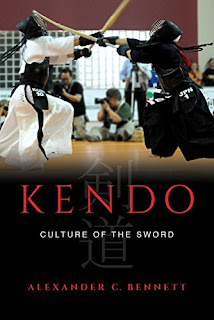
I'm reading Kendo: Culture of the Sword by Alexander C. Bennett. I started reading it to better understand the history of Kendo, which I've mentioned a bit here. As you might imagine, Kendo started as a battlefield practice. It was one manifestation of the combat art employed by sword-wielding Japanese warriors. Over time, as the leaders of Japan sought to reduce bloodshed, sword combat became less common. Swords were used in warfare, but as Japan became more peaceful, the numbers of "sword battle veterans" diminished. Various parties sough to continue to infuse the spirit of sword fighting in certain elements of the citizenry, leading to the development of Kendo and its sport elements. I'm currently reading the part of the book that deals with the re-militarization of Kendo, due to the wars Japan fought in the first half of the twentieth century. This is a fascinating phenomenon which I have not encountered (yet) with other martial arts. Following World War II,...

Protecting U2 and Their Fans

Image
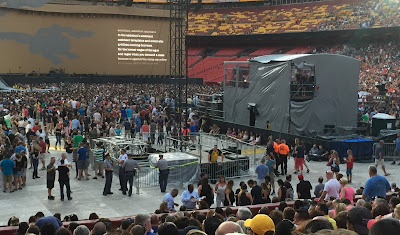
Last night Mrs B and I were fortunate to attend the U2 concert at FedEx Field in Landover, MD. Between the opening act and U2's first set, I enjoyed observing the physical security arrangements and seeing them in action. Shortly before taking the photograph at left, I saw a probably intoxicated fan run towards the mass of general admission attendees in the center of the photograph. He was pursued by a yellow-shirted member of the CSC Event Staff. The man either fell or was pushed to the ground by the CSC staffer. Shortly afterwards a few of the orange-shirted "Apex Security Group" approached the scene. The CSC and Apex crew removed the fan from the field, one person on each side, slightly behind the fan, each holding one arm behind the fan, at the wrist. A few minutes after the fan was escorted from the field, a few Prince George's County uniformed police officers spoke with other CSC staffers, then followed the path taken by the man escorted from the field. They were...

Longevity in the Martial Arts

Image
How long can we train in the martial arts? As a 45-year-old who returned to practice in January 2016, I've been pondering this question for the past few weeks, in three separate ways. First, in episode 161 of the Whistlekick podcast , a practitioner of the Chinese martial arts said that as a younger man he focused on the so-called "hard" or "external" styles, and as he aged he transitioned to the "soft" or "internal" styles. For example, you might begin learning Wing Chun or Kung Fu, then migrate to Tai Chi, or spend more time on Kung Fu forms instead of sparring. I have done some Wing Chun and Tai Chi, but the majority of my Chinese practice involves Kung Fu forms. Second, I participated in Professor Pedro Sauer's Brazilian Jiu-Jitsu spring camp in Herndon, VA. Professor is in his late 50s and he talked about the importance of learning technique rather than relying on strength. He said it is good to have strength, but you should "ke...